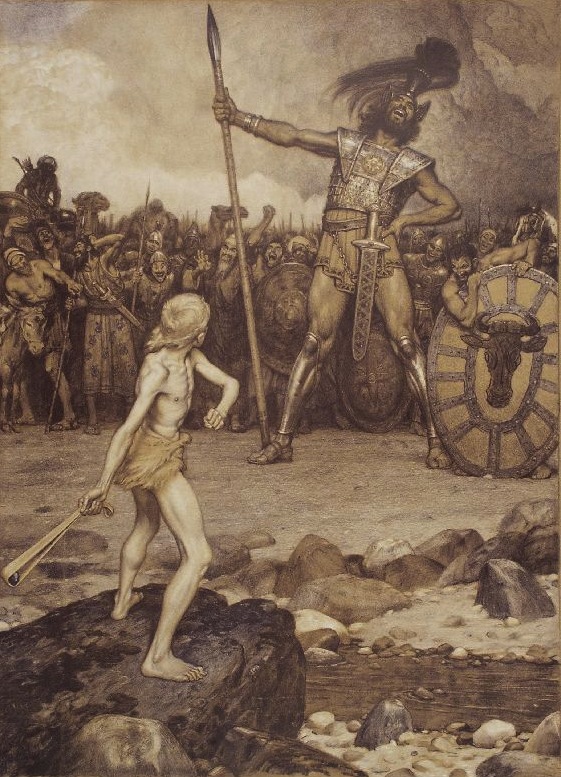
Two armies faced each other across the Valley of Elah, camped on opposite ridges with the valley floor between them. Neither would come down, because whoever descended first would have to fight uphill.
So the Philistines sent out a champion instead, and offered single combat: one man against one man, winner takes the war.
The giant
Goliath of Gath came out every morning and every evening for forty days.
The description in 1 Samuel 17 is unusually detailed about his equipment: a helmet of brass, a coat of mail weighing five thousand shekels, greaves of brass, a brass javelin between his shoulders, and a spear whose staff was "like a weaver's beam" with a head of six hundred shekels of iron. A man walked in front of him carrying his shield.
His height is given in the Hebrew Masoretic text as "six cubits and a span" — around nine feet nine inches. It is worth noting honestly that the oldest manuscripts do not agree. The Dead Sea Scrolls copy of Samuel, and the Greek Septuagint, both read four cubits and a span, which is closer to six feet nine — still enormous for the period, when the average man stood around five foot three, but a soldier rather than a monster.
Either way, the Israelite army's response was unanimous. "They were dismayed, and greatly afraid" (17:11). Forty days, and nobody went down.
The errand boy
David was not a soldier. He was the youngest of eight sons, left at home to keep his father's sheep while his three eldest brothers served under Saul.
Jesse sent him to the camp with ten loaves and ten cheeses, and instructions to bring back news. He arrived, heard Goliath's challenge, and started asking questions — specifically, what the reward was for killing him.
His eldest brother Eliab heard him and was furious:
"Why camest thou down hither? and with whom hast thou left those few sheep in the wilderness? I know thy pride, and the naughtiness of thine heart; for thou art come down that thou mightest see the battle." (17:28)
It is a very human moment, and easy to skip past. The first opposition David meets is not the giant. It is his own family, telling him in front of other men that he is a show-off who should go back to the sheep.
Refusing the armour
Brought before Saul, David made his case — not with a theological argument but with a work record. He had killed a lion and a bear that came after the flock, grabbing them by the beard and striking them. The Philistine would be the same.
Saul dressed him in the royal armour: a brass helmet, a coat of mail, a sword. David tried to walk in it and could not. "I cannot go with these; for I have not proved them" (17:39).
This is the hinge of the whole story, and it is usually read as humility. It is better read as competence. David declined to fight in a style he had never trained in, against a specialist, and chose instead the only weapon he had used every day of his working life.
He took his staff, chose five smooth stones from the brook, and went down with a sling.
Why the mismatch runs the other way
Set the romance aside and look at what each man actually brought.
Goliath was heavy infantry. His armour, by the weights given in the text, ran to something like fifty kilograms. His weapons were all designed for close combat, and his shield was carried by someone else. He had a shield-bearer because he expected to close with another armoured man. He could not move quickly, and he may not have seen well — scholars have long noted that the text has him led out by an attendant and that he calls to David to come to him rather than advancing.
David was light artillery. A sling in trained hands was a serious battlefield weapon, not a child's toy: judges in Israel are elsewhere said to have slung stones at a hair's breadth and not missed. A stone from a sling leaves at speeds comparable to a modern handgun round, and the target David needed was the one patch of Goliath's body the armour did not cover.
So the fight was not a small boy against a big man. It was a ranged weapon against an opponent who could not close the distance, choose the ground, or protect his face.
Goliath expected a duel. David never agreed to have one.
What David said
The exchange before the fight is the part the chapter cares about most.
Goliath, seeing a boy with a stick, took it as an insult and cursed him by his gods. David answered:
"Thou comest to me with a sword, and with a spear, and with a shield: but I come to thee in the name of the LORD of hosts, the God of the armies of Israel, whom thou hast defied... for the battle is the LORD's, and he will give you into our hands." (17:45, 47)
Then he ran at him. The text is specific about that — David hurried, closing fast, which is exactly what a slinger does to get a shot off before the gap closes.
One stone, in the forehead. Goliath fell on his face. David had no sword of his own, so he used Goliath's.
The reading that survives
The story is told as the triumph of the small over the large, and that reading is not wrong — the chapter itself frames it as God defending His name through someone the professionals had written off.
But the detail the text keeps pressing on is choice of ground. David's advantage was never size or strength. It was that he knew precisely what he was good at, refused to be dressed up as something he was not, and declined to fight the battle his opponent had spent forty days preparing for.
Read it yourself
The full account is 1 Samuel 17. The chapter runs to fifty-eight verses and takes about eight minutes to read.
Comments
Sign in to leave a comment.
New here? Already have an account?