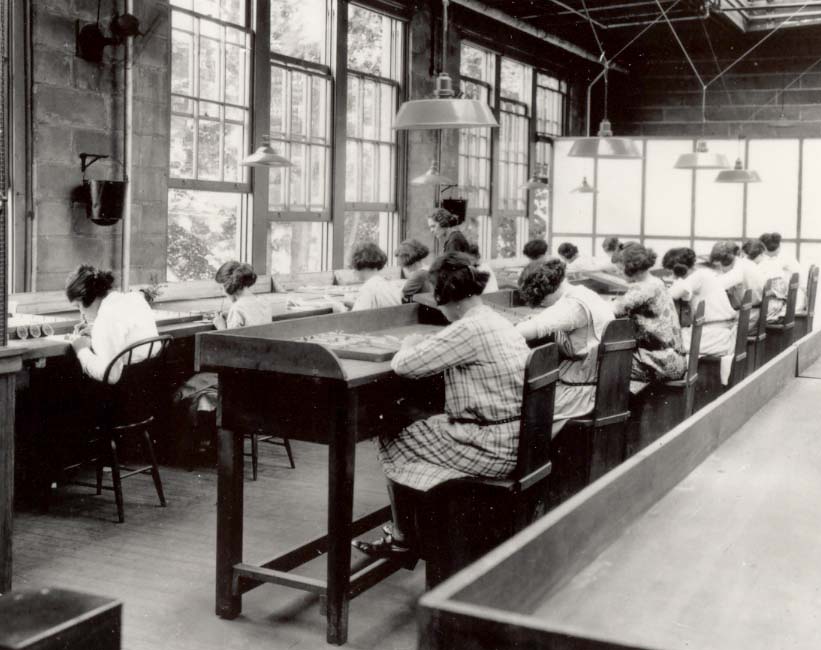
The job was considered a good one.
During and after the First World War, American factories needed luminous watch dials — for soldiers, for pilots, for anyone who had to read an instrument in the dark. The glow came from radium mixed into paint, and painting the fine numerals onto a watch face required a steady hand and a very fine brush.
The work went to young women, many of them teenagers. It paid well above the usual rate for factory work. At the United States Radium Corporation plant in Orange, New Jersey, and later at Radium Dial in Ottawa, Illinois, hundreds of them lined up to do it.
Lip, dip, paint
The brushes lost their point after a few strokes. The technique the company taught for restoring it was to draw the bristles between the lips.
Lip, dip, paint. Hundreds of times a shift.
The women asked whether the material was dangerous. They were told it was not. Radium in this period was not a known hazard to the public — it was a wonder substance, sold in tonics, toothpaste, face cream and suppositories as a health product.
So they had fun with it. They painted their fingernails to surprise boyfriends. They painted their teeth before going out dancing. They wore their good dresses to work so the drifting dust would make them shimmer on the way home. They were nicknamed the ghost girls, and they walked home glowing.
Inside the plants, meanwhile, the chemists handling the same material worked behind lead screens, with tongs and masks.
What radium does
Radium-226 is chemically similar to calcium. The body cannot tell the difference, so it files it where calcium goes: into bone.
Once there it stays, with a half-life of 1,600 years, irradiating the surrounding bone and marrow from the inside. The consequences arrive slowly, and then all at once.
They began appearing in the early 1920s. Teeth loosened and fell out. Extraction sites refused to heal. Jaws developed abscesses, then began to crumble — a condition that acquired its own name, radium jaw, in which sections of mandible could be lifted out by hand. Anaemia followed as the marrow failed. Then spontaneous fractures, sarcomas, and legs that shortened as bone collapsed.
Grace Fryer, a dial painter who had left to work as a bank teller, lost her teeth and then found her jaw disintegrating. Her spine began to collapse; she eventually needed a steel back brace to sit upright.
The company knew
This is the part that converts a tragedy into a scandal.
US Radium commissioned medical investigations and received findings linking the illnesses to radium exposure. It did not act on them. It disputed them, suppressed them, and in at least one documented instance distributed a report under another organisation's name that reached the opposite conclusion.
Women who fell ill were examined by physicians the company sent, and told the problem was something else: syphilis, in several cases — a diagnosis that carried enough social stigma to keep a young woman quiet and to discredit her if she did not stay quiet.
Dr Harrison Martland, the Essex County medical examiner, finally developed tests that detected radioactivity in the women's breath and bones, and published findings in 1925 that established the mechanism.
That same year, US Radium's own chief chemist and co-founder, Dr Sabin von Sochocky — the man who invented the paint — was dying of the effects of radium exposure. He died in 1928 of aplastic anaemia.
Suing while dying
Grace Fryer spent two years looking for a lawyer willing to take the case. In 1927 she found Raymond Berry, and five women filed suit: Fryer, Katherine Schaub, Quinta McDonald, Albina Larice and Edna Hussman. The press named them the Radium Girls.
They were running out of time in a literal sense. New Jersey's statute of limitations required a claim within two years of exposure — and the disease took five years or more to show itself, which meant the law as written made it almost impossible to sue at all.
The company's lawyers used delay as strategy, seeking adjournments into dates months away. By the time of the hearings, several of the plaintiffs could not raise their arms to take the oath.
Two of the five were so weakened they had to be carried into court. None expected to live long enough to see a verdict.
The case settled in June 1928, under considerable public pressure: $10,000 to each woman, a $600 annual pension for life, and payment of medical and legal costs. It was not justice in proportion to the harm. It was, at the time, extraordinary.
In Illinois, Catherine Donohue pursued Radium Dial through a parallel fight, giving testimony from her deathbed at home because she could not reach a courtroom. She won in 1938, and the company lost every appeal. She died that July, weighing under thirty kilograms.
What they left behind
The dial painters changed American law. Their cases helped establish that workers could sue employers for occupational disease with a long latency period — a principle that had not existed before and that underpins compensation for asbestos, benzene and industrial carcinogens generally. The publicity fed directly into the push for industrial safety regulation that eventually produced modern occupational health standards.
There is also a strange, concrete legacy. Because radium stays in bone and is measurable, surviving dial painters were studied for decades, and the data became the foundation for internal radiation dose limits used in medicine, nuclear work and radiation protection worldwide.
Their graves remain radioactive. In Ottawa, Illinois, a statue of a dial painter holding a brush and a tulip stands in the town where the factory was.
Sources
- Kate Moore, The Radium Girls: The Dark Story of America's Shining Women (Sourcebooks, 2017).
- Claudia Clark, Radium Girls: Women and Industrial Health Reform, 1910–1935 (University of North Carolina Press, 1997).
- Harrison S. Martland, "Some Unrecognized Dangers in the Use and Handling of Radioactive Substances", Journal of the American Medical Association (1925).
- Image: dial painters at work, c. 1922, public domain, via Wikimedia Commons.
Comments
Sign in to leave a comment.
New here? Already have an account?